
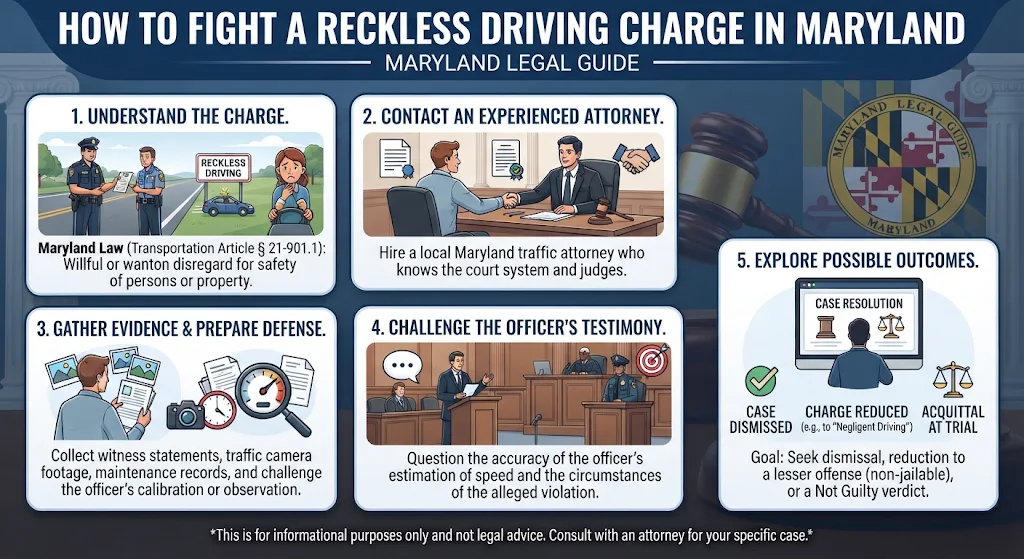
Getting a reckless driving citation in Maryland feels different than a normal ticket, and it should. Since October 1, 2025, driving 30 miles per hour or more over the posted limit can be charged as reckless driving, and the offense now carries possible jail time. That means this is a criminal traffic case, not a ticket you simply pay and forget.
If your first question is whether the charge is a felony, what the full penalties are, or how the points work, read our penalty guide here: https://www.houlonberman.com/blog/is-reckless-driving-a-felony-in-maryland-penalties-points-and-the-new-jail-rule/. This article answers the next question people ask: what can I actually do about the charge?
Why You Should Not Just Pay It
A reckless driving conviction can bring up to 60 days in jail, a fine up to $1,000, and 6 points. Six points can trigger MVA action, raise your insurance rates, and cause problems for commercial drivers and anyone whose job depends on a clean record. Jail is not common for a first offense with a clean history, but the risk is real, especially in high speed cases. Because a mandatory court appearance often applies, you cannot treat the citation as optional paperwork.
What Prosecutors Must Prove
Maryland reckless driving generally means driving with wanton or willful disregard for the safety of people or property. Under the newer law, certain high speed conduct fits the charge more directly. The State still has to prove each part of the case beyond a reasonable doubt. Your defense looks for the weak links.
Where Defenses Usually Come From
Most guides list generic defenses. In practice, strong cases are built on specific facts. These are the areas a careful defense reviews first.
1. The speed measurement. If the case rests on radar, lidar, or pacing, the details matter. The officer’s training, the device calibration, the angle, the traffic around you, and the exact stretch of road can all affect whether the speed reading holds up. Tight traffic is especially important, because a device can lock onto the wrong vehicle.
2. The officer’s observations. Was the officer in position to see what they say they saw? How long did they watch you? What did they write down at the scene versus what they say in court? Gaps between the notes and the testimony can help.
3. Video evidence. Body worn cameras, dash cameras, and nearby business or traffic cameras may show the road conditions, your driving, and the stop. Request video early, because some footage is deleted on a schedule.
4. Road and weather conditions. Speed that looks extreme on paper can look different with a clear road, light traffic, and good visibility. Conditions do not excuse unsafe driving, but they can change how the court views the level of risk.
5. Charging errors. Wrong dates, wrong locations, missing details, or a mismatch between the citation and the evidence can create openings.
The Realistic Goal: Reduce the Charge
Not every case ends in a dismissal. A very common goal is a reduction to negligent driving. Negligent driving is a fine only offense with a lower maximum penalty and far fewer points than reckless driving. For many drivers, that outcome removes the jail risk and protects the license, even if the case is not thrown out. The best path depends on your driving record, the facts, and the court.
Step by Step: What to Do After You Are Cited
- Read the citation carefully. Note the charge, the court date, and whether a court appearance is required.
- Do not ignore the date. Missing court can lead to a warrant or license problems.
- Write down everything now. Record the road, weather, traffic, time, and what the officer said while your memory is fresh.
- Save any proof. Dash camera footage, phone location data, and witness names can help.
- Avoid posting about it. Social media statements can be used against you.
- Request the State’s evidence. This can include the officer’s notes, device records, and video.
- Talk to a Maryland traffic defense lawyer early. Early review gives you more room to preserve evidence and negotiate.
Insurance and Employment Impact
A reckless driving conviction can lead to higher premiums or policy changes. If you drive for work, a conviction may affect job eligibility. If you hold a professional license or security clearance, you may have reporting duties. These collateral effects are often the reason people choose to fight instead of paying.
What Not to Do in Court
Do not argue with the officer, guess about your speed, or admit to driving fast without understanding the consequences. Statements made in court can be used in your case. If you do speak, stay calm and stick to facts.
This article is general information, not legal advice for your situation. Laws and enforcement practices can change, so confirm current rules with a licensed Maryland attorney.
Q&A
Can I fight a reckless driving ticket in Maryland without a lawyer?
You can, but the stakes are higher now because jail is possible and points are significant. A lawyer can review evidence, negotiate with the prosecutor, and prepare for trial.
Is reckless driving a payable ticket in Maryland?
Reckless driving is a criminal traffic offense, and a court appearance is often required. Do not assume you can mail in a payment, and check your citation for instructions.
Can reckless driving be reduced to negligent driving?
Yes, that is a common negotiation goal. Negligent driving has a lower maximum penalty and fewer points, but the outcome depends on your facts and record.
What if I was going 30 mph over the limit?
That speed can now be charged as reckless driving in Maryland. The State still has to prove the speed reliably, so the evidence behind the measurement matters.
Will I go to jail for a first offense?
Jail is possible, but it is not typical for a first offense with a clean record. The risk rises with very high speeds, prior history, or a crash.
Should I go to court if I plan to hire a lawyer?
Follow your citation instructions and let your lawyer advise on appearances. Missing a required date can create bigger problems.
How long should I wait before getting help?
As soon as possible. Evidence such as video footage can be lost, and early preparation gives you more options.